

Litter prevention
What is the litter problem?
Scenes of litter hidden in the shrubs and carpark, pieces of plastics, glass and cigarette butts on the beach, and rubbish overflowing from bins are all too familiar wherever we go. Litter is no doubt a significant environmental problem in Sydney.
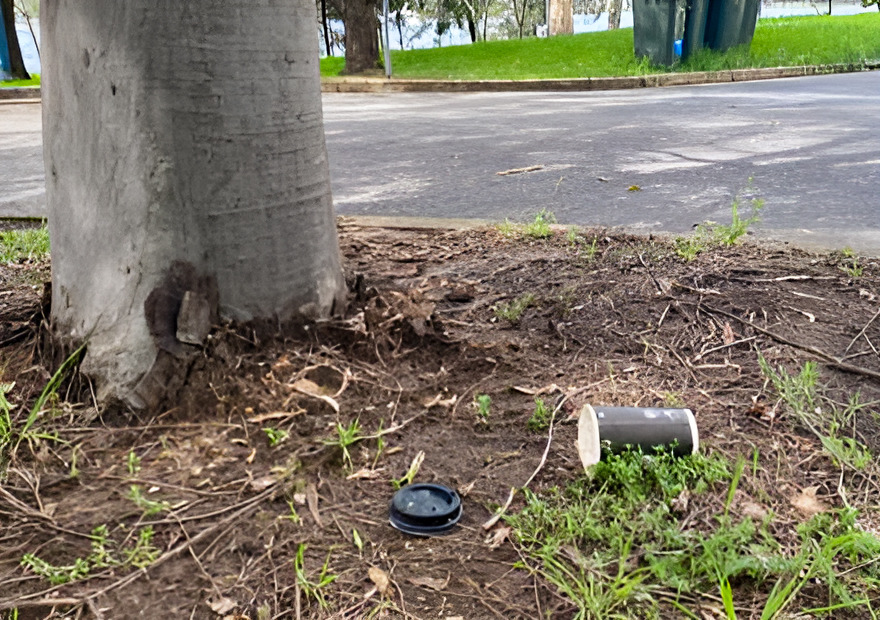
But what exactly is litter?
Litter is a material that has been discarded in the wrong place. The current definition of litter is material up to the size of a shopping bag; anything larger is considered illegal dumping.
Common litter items include:

Takeaway food and beverage containers

Confectionary and snack wrappings
Drink containers (plastic and metal)
Cigarette butts

Bottle caps

Plastic straws
Pieces of glass bottles

Advertising and promotional material left in the wrong place
Did you know?
Litter costs NSW more than $500 million a year[1].
In the navigable waters of Sydney Harbour, 3,500 cubic metres of rubbish is continuously removed by the Transport for New South Wales annually[2].
5,000 tonnes of litter enter Sydney’s waterways each year[3].
Seabins captured 16.5 tonnes of marine litter for the months of July 2020 to June 2021. This is the equivalent of covering 351 football fields with plastic shopping bags[4].
Impacts of litter
A littered environment has many consequences and some of these may not be immediately obvious.
Impact
Visual
Outcome
Litter makes places look unsightly and uncared for and attracts more litter. This reduces the amenity of outdoor public space that is essential for community recreation and wellbeing.
Impact
Health
Outcome
Some litter, such as broken glass and syringes, can injure people. The presence of litter makes it more likely that other serious anti-social behaviour will occur, like graffiti and property damage.
Impact
Environmental
Outcome
Litter damages natural environments and harms wildlife, on land and in our waterways.
Ingestion of plastic litter has been found to cause harm to animal populations.
Impact
Economic
Outcome
Litter has heavy financial costs borne directly by the people of NSW. A 2016 MRA study estimated $167 million to $198 million a year is spent on cleaning up litter in NSW. Most of this money is spent by councils on behalf of their residents and ratepayers. Recent research (2022) found that litter costs NSW more than $500 million a year when indirect costs are included, e.g. loss of visual amenity.
Impact
Resource
Outcome
Easily recyclable resources, such as drink bottles, are lost when people litter.
Cleaning up litter is expensive and takes up valuable time and resources that can be spent on other community needs.
That’s why it’s important to shift our focus from clean up to litter prevention – actions that will prevent litter from being generated in the first place!
Managing Litter
What is currently being done?
NSW Goverment
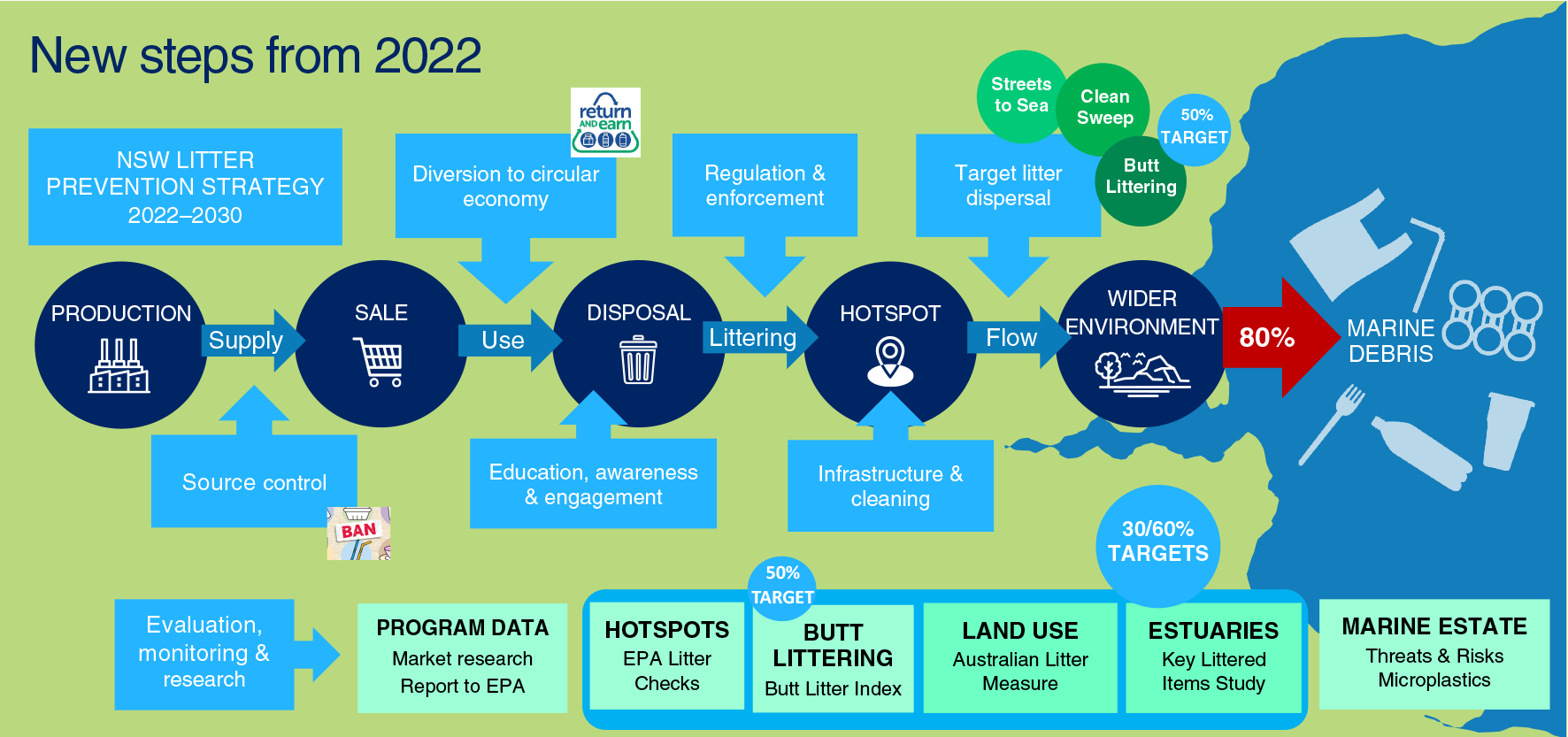
Litter prevention policy in NSW is led by the NSW Government. The NSW Government has set an ambitious target of 60% overall litter reduction and 50% cigarette butt littering behaviour reduction by 2030 and 30% plastics reduction by 2025 [5]. To achieve these targets, seven approaches have been set to integrate the elements of litter prevention across the litter journey.
Approach 1
Source control
To reduce or eliminate items and material before they are even created or introduced into the economy, in order to reduce waste and litter. Initiatives include the recently introduced Plastics Action Plan to phase out targeted plastics items and voluntary phase-out of problematic items.

Approach 2
Diversion to a circular economy
To divert key items that would otherwise be littered, towards recycling and reuse initiatives. This is exemplified by the Return and Earn program which started in December 2017 to reward responsible disposal of eligible beverage containers.

Approach 3
Education, awareness and engagement
To change people’s knowledge, attitudes and behaviour around litter. Community campaigns raise awareness about littering and build the norm that littering is the wrong thing to do, and responsible disposal of rubbish is the right thing to do.

Approach 4
Regulation and enforcement
Of litter laws. A key outcome is to increase the perception that you will be seen and fined if you litter.
Approach 5
Infrastructure and clean-up
To provide clean, well-functioning public place infrastructure, such as footpaths, street furniture or signage, to help reduce littering by sending a message that litter doesn’t belong. The right bin in the right place makes it easier for people to dispose of their rubbish correctly and sends a signal about what people are expected to do with their rubbish.

Approach 6
Targeted programs
To deal with specific items, practices and pathways that lead to the dispersal of litter into the wider environment. This includes the Operational Clean Sweep, cigarette butt litter prevention program and Streets to Sea program.

Approach 7
Monitoring, evaluation and research
To better understand what is working well and inform ongoing management approaches.
Transport for NSW
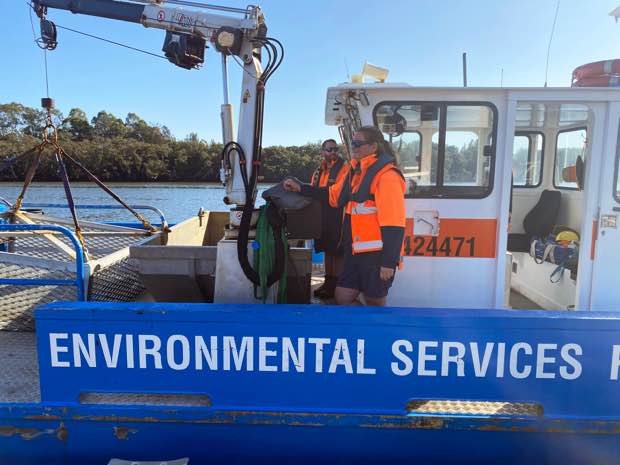
Maritime Environmental Services (Transport for NSW) cleans the navigable waters of the Port Jackson (Sydney Harbour) and tributaries, Parramatta and Lane Cove Rivers, public beaches and foreshores everyday. The team traps and removes floating litter and debris from the waters for disposal to relevant waste processing services. It is recorded that 3,500 cubic metres of rubbish is continuously removed annually[7].
Local councils
Local councils have been responding to the community’s desire for litter-free public places for many years with litter prevention projects and campaigns. The 21 local councils of the Greater Sydney Harbour catchment focus on litter through different organisational sections, covering a range of litter prevention activities, including education, clean-ups, infrastructure and enforcement.
See our Current Snapshot page for a full breakdown of these activities in your local LGA.
References
1. NSW Environment Protection Authority (2013), Litter Research, NSW EPA, https://www.epa.nsw.gov.au/your-environment/litter/research
2. Transport for New South Wales (2014), Sydney Harbour Environmental Services, TfNSW, https://roads-waterways.transport.nsw.gov.au/about/environment/sustainability/sydney-harbour.html
3. NSW Environment Protection Authority (2013), NSW Litter Prevention Kit: Things you should know about litter and litterers, NSW EPA, https://www.epa.nsw.gov.au/~/media/EPA/Corporate%20Site/resources/litter/130800-lpk-things-know.ashx
4. Seabin (2021), Marine litter in Sydney Harbour Impact Report, https://www.uvex-safety.com.au/fileadmin/www.uvex-safety.com.au/Media/2021_Marine_Litter_In_Sydney_Harbour_Impact_Report-compressed.pdf
5. NSW Environment Protection Authority (2022), NSW Litter Prevention Strategy 2022-30, NSW EPA. https://www.epa.nsw.gov.au/your-environment/litter/nsw-litter-prevention-strategy
6. NSW Environment Protection Authority (2022), WASM Litter Prevention Grants: Guidelines 2022-27, NSW EPA. https://www.epa.nsw.gov.au/-/media/epa/corporate-site/resources/grants/litter/22p4199-wasm-litter-prevention-grants-guidelines-2022-27.pdf?la=en&hash=571D3648373F6E04C16B2DF3BF8AE58FE4D22E35
7. Transport for New South Wales (2014), Sydney Harbour Environmental Services, TfNSW, https://roads-waterways.transport.nsw.gov.au/about/environment/sustainability/sydney-harbour.html